The Element Space & Wait Time
The Element Space & Wait Time
🎥 Watch the video:
The Element Space & Wait Time by Amy Haysman
I had an experience this week in one of my yoga classes with a 10-year-old girl that I believe could help you see the value in kids who seem to distract everyone else by taking up a lot of room, making noises, and craving attention.
An intense desire to constantly get filled up by other people’s energy is one way that having an overabundance of the element Space can manifest. These are the kids who claim the whole room and need constant input — and they can be tricky for a teacher to manage.
A few weeks into the session, I let this girl know — with no fuzzy boundaries — that she is better than the behavior she was bringing. Any actions that were unbecoming of her best self (the girl she is when she feels proud and great) would not be tolerated in the yoga room.
If she needed to scream, run, or fall down, she could do so outside in a place where I could still see her, but the others could not. At the same time, I continued to fill her up with the truth of what she was doing well: showing up enthusiastically, helping others, holding crow pose, being open to new experiences.
Each class, I pointed at the door less and less. She never actually went outside. The non-verbal reminder was enough.
Shifting Space with One-Pointed Focus
Kids who seem to be in a Space all their own — that the rest of us aren’t occupying — need to be taught how to focus. So one-pointed focus became my theme for the week.
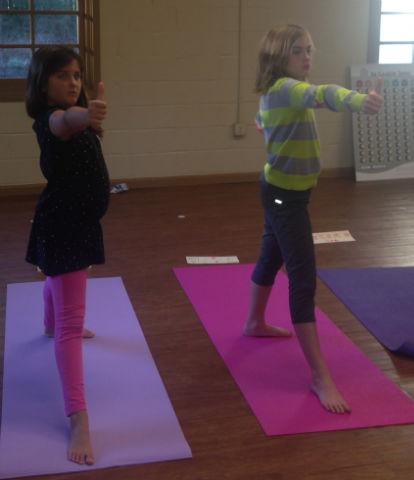
I taught them to use a drishti — a non-moving point of gaze that changes depending on the pose. They moved through a sequence of intense postures requiring deep focus, and I asked them to consider:
What would be better in your life if you could focus on one thing at a time?
Would anything change at school? At home? This girl wanted it badly. She was painfully familiar with the misery that comes from not being able to pay attention.
Stillness + Story
After the sequence, they were ready for a long Savasana to absorb the benefits. During this rest, I read them the story The Three Questions — about a boy seeking answers:
- When is the best time to do things?
- Who is the most important one?
- What is the right thing to do?
The story follows his journey and a moment where he ends up saving a mother panda and her baby by being in the right place at the right time. After reading, I asked the class:
How does this story connect to one-pointed focus?
Many had great answers. “He had to focus to hear the cries,” one said. “He wouldn’t have been able to help if he wasn’t focused on helping the turtle,” said another.
And Then, the Spacious One Spoke
The girl who had been the most “spacious” of all was still lying down, sprawling freely. She raised her hand, began to speak, then laughed, then nodded, then backtracked, then wiggled around. Ten seconds of silence passed.
This is where the concept of wait time comes in.
As instructors of children who take up a lot of space, our instinct is often to jump in and prompt, contain, or move them along. But in that moment, I held space for her. I trusted she would gather herself. And when she finally did speak, it was profound.
She said the boy in the story heard three different answers to his questions — and none of them felt right. He stayed focused on finding his own truth instead of taking someone else’s answers. By allowing her the space to collect her thoughts, we all received a powerful insight:
Finding your own Truth requires space… and time to listen inside.