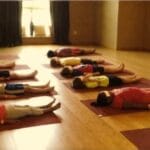
I Am What I Am – A Grounded Kids Yoga Pose That Builds Emotional Integration and Trust
Sa Ta Na Ma. This four-part chant and mudra sequence, originating from Kundalini Yoga, can quietly unlock transformation, especially in children. We call this the “I Am What I Am” pose, and it continues to reveal its value every time we teach it.
Each syllable is paired with a finger-to-thumb tap that supports energy flow to the brain:
SA – Infinite
TA – Birth
NA – Ending
MA – Rebirth
We first witnessed its impact through Radiant Child Yoga training with Shakta Kaur Khalsa. In our own classes since, we’ve seen this pose support regulation, clarity, and confidence, especially for neurodivergent students.
Yoga That Sees the Gift Before the Label
The first reaction we show a child, through our face, body, or tone, isn’t always what’s in our heart. Especially in high-pressure moments, it’s easy to focus on behavior instead of presence. But children, particularly those labeled with sensory or behavioral differences, pick up on incongruence. They feel when we’re not aligned.
At Grounded Kids Yoga, we teach from the philosophy of intrinsic goodness. Rooted in Anusara Yoga and aligned with Tantric teachings, this belief reminds us that there is nothing to fix. Every child holds intelligence, resilience, and light. Our job is to help reveal it.
As Allison Morgan, MA, OTR and Radiant Child Yoga Trainer says:
“Don’t try to create change based on what children don’t have, or can’t do. Look deeper and acknowledge what they can do. Let them know that you notice.”
Learn more about how yoga supports kids emotionally and cognitively in our post:
The Benefits of Yoga for Kids with Grounded Kids Yoga
From Practice to Real Life
The purpose of yoga isn’t performance. It’s integration. Of body, breath, emotion, awareness. The true impact shows up not during class, but later, at school, at home, or in hard moments when no one is watching.
Students chant “I am so calm,” “I am in charge,” or “I am strong” during practice. But the real transformation is when those words come back to them in real time, like during a test, conflict, or moment of overwhelm.
One student told her teacher she used the pose during a long exam. She closed her eyes, tapped her fingers silently, and whispered her own affirmation: “I can do this.” No prompting. Just her, her breath, her body, and the pose. That’s what transfer looks like.
For another story of this in action, read: How a Student Used Yoga During a Test – Naomi’s Story
How to Teach the Pose With Integrity
Here’s how we teach the “I Am What I Am” pose across settings:
- Begin with breath. Anchor their awareness in their body.
- Guide the finger taps using both hands by pressing the thumb to each finger beginning with the index, then middle, then ring, then pinky finger as you chant each sound SA TA NA MA or substitute affirmations:
→ “I am ready, I am steady, I am clear, I am here.”
→ “I am calm, I am strong, I am focused, I belong.” - Repeat several times first out loud, then in a whisper, then double the time silently in your mind, then return to a whisper, finishing by chanting again out loud.
- Make it rhythmic and grounded in sensation.
- Repeat it consistently so it becomes internalized.
- Let kids make their own affirmations when they’re ready.
This pose is more than a calm-down tool. It helps rebuild internal trust. It reminds children that they can regulate, return to center, and begin again, anytime, anywhere.
Looking for a full sequence of short classroom-ready practices that pair with this pose? Try our Focus in Time Downloadable Kit
See the Good, Always
This pose teaches us, too. To pause. To lead with warmth. To believe in a child’s brilliance, especially when it’s hard to see.
As Shakta Khalsa asks, “When you look at me, what do you see?”
Let the answer always be: the gift.
All children, especially those who have been labeled as “Special Needs,” are keenly aware of the subtle energy of adults. In other words, you can’t hide behind a smile or say one thing while believing another. They will know and what you teach them through mixed messages is that either adults can’t be trusted or that they can’t trust their intuition. Since it’s natural to notice differences as a way of making sense of things and most of us have been sizing up kids for years, that screaming kid at the grocery store, the student who doesn’t make eye contact, the boy who obviously eats too much candy, the girl who is just not paying attention, we need a surefire way to literally change our mind. The solution is simple and works every time when it is the first thing you do, always. See the good. This is the most important element to an Anusara® yoga class and (of course) Grounded teachers do it too!
It is the Tantric philosophy of intrinsic goodness. When you are grounded in this truth, you realize that there is no need to fix a child but rather help to reveal the perfection that is already there.
Yoga is an invitation to this revelation.
That’s why yoga helps all learning for every child. There’s a booming branch of yoga for kids called “yoga for kids with special needs.” What we have found to be true is that the yoga teachers, OTs, PTs and parents who have the greatest success stories working with this growing population treat the kids and not the diagnosis. Here are a few grounded tips.
- Look for the good first and always.
- Find out if the individual has anything going on in their life that would require you to modify a pose or a pose category such as inversions.
- Start with the breath and then move into poses.
- If a pose, a chant or a breathing technique helps the person feel better, do it often.
- Be sensitive enough to know why a child may be resisting a certain pose and change your plan when necessary.
Want to teach this and other poses with confidence? Join our
Grounded Kids Yoga Certification and CEU Trainings
Or use our Pose Cards to help children personalize and practice at their own pace.