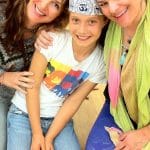
obama in classroom

← Back to the blog

Kids Say The Deepest Things

Last week President Obama visited College Heights Early Childhood Education Center where I teach yoga to 1 year olds and up since last year. When I asked my students several questions regarding the time they spent with President Obama, my passion for the importance of teaching yoga to preschoolers was completely validated. Read on and I’m sure you will appreciate the brilliance of these kids as much as I did. obama in classroom

My first question was to my Toddler class. I simply asked “how was seeing the President?” They are 2 years old and these are some of their answers. “ He is as big as a mountain.” “He is strong.”  “He has big ears.” “He smiles”.

I probed a little deeper with the older kids. I inquired, “How is meeting President Obama related to what you have been learning in Yoga? “ These kids are 3 and 4 years old and their answers blew my mind, put a smile on my face and no doubt melted my heart. These are some of their responses. 

 “He is tall and strong like a mountain.”

 “He stops and breathes when he talks.”

 “He stands strong.”

 “His heart is open.”  Then I said “please tell me what makes you think that?” The little boy who is 4 said, “Because Ms. S. (that’s me J), his shoulders are back and that keeps the heart open.”

A few other amazing answers from these children are “His words are clear.”

“He is nice to every body because his heart is open.”

“His heart is open so he shares his light with everybody.”

“He is happy when he sits because he sits up straight and lifts his heart.”

“He has power in his belly.”

We all have moments in our lives when we say to ourselves; wow I have done my job well.  Kids listen. They are hungry for information. They remember. It’s very important for us teachers to teach them well. With answers like that, I know I have done my share. Let your light shine. Namaste’.

More to Explore

  • When Age Matters

    I want to share some experiences and some trial and errors to encourage teachers to continue with their mission, even when it seems like you’ve hit the wall, or run out of ideas, or question if you are making a difference.
    Yes, we all hit the wall. If we didn’t, we wouldn’t know what’s on the other side. The climb over can be tough, but anything that’s easy is just that, easy. Teaching children is a challenge. Teachers need to be able to tap into their own light, with conviction, to put forth their best effort, class after class, year after year. All teachers understand that, right? But, what if you are teaching pre-school children? What if you are introducing them to something brand new and want them to love it so they will continue? What if you were teaching them yoga?

  • A Grounded Guide for Kids: Inspired by the Wisdom of The Little Prince

    Grown-ups like numbers. When you tell them about a new friend, they never ask questions about what really matters. They never ask: “What does his voice sound like?” “What games does he like best?” “Does he collect butterflies?” They ask: “How old is he?” “How many brothers does he have?” “How much does he weigh?” “How much does his father make?” Only then do they think they know him. If you tell grown-ups, “I saw a beautiful red brick house, with geraniums at the windows and doves on the roof…” They won’t be able to imagine such a house. You have to tell them “I saw a house worth a hundred thousand francs.” Then they exclaim, “What a pretty house!”…That’s the way they are. You must not hold it against them. Children should be very understanding of grown-ups.
    — The Little Prince, Antoine de Saint-Exupery
    So Children, how do you master the art of Grown-up relationships one conversation at a time?

  • The Ground Truth

    Have you ever heard the term “The Ground Truth”? Spies say it when they want to know what really went down, no cover-ups and no interpretations. Apparently in life or death spy situations it’s important to know the ground truth in order to move forward in the mission. In NASA, the ground truth is part of the calibration process where a person on the ground makes a measurement of the same thing the satellite is trying to measure at the same time. The two answers are then compared to help evaluate how well the satellite instrument is performing.